- Lebenslange Garantie
- 100 % sichere Zahlungen
- Kostenloser Versand bei Bestellungen über €350
- Schneller Versand mit DHL Express
- Nur für Fachleute
- Keine Mindestbestellmenge erforderlich
- Moissanit mit GRA-Zertifikat
- NUR GEPRÜFTE PIERCER

What the karat changes on the bench, at the counter and in your stock.
By The Tremun Team · Barcelona, Spain · Updated 18 November 2026
14K gold is 58.5% gold. 18K gold is 75% gold. The rest is alloy, and the alloy sets the colour, the hardness and how a piece wears. This guide is for piercers and studio buyers. It compares 14K and 18K gold body jewellery honestly, because both karats have a place in a professional studio. By the end, you can choose a karat for each client. You can also check a gold piece at the bench and write a clear email to your supplier. It comes from more than 10 years of experience supplying professional piercers across Europe.
Kurz gesagt
Five rules for choosing gold
14K58.5% gold
Best for: everyday pieces, a lighter yellow
18K75% gold
Best for: signature pieces, curated ears, deep colour
Karat is the share of pure gold in an alloy, measured in 24 parts.
14K means 14 parts gold in 24. The exact maths gives 58.3%, but the trade standard is 58.5% gold. This figure is a minimum, never rounded down. 18K means 18 parts gold in 24, which is 75% gold.
So a 14K piece is 41.5% other metals. An 18K piece is 25% other metals. That difference drives almost everything else in this guide.
Gold content
Pure gold is very soft. Other metals make it harder and change its colour.
Yellow gold usually mixes gold with silver and copper, often with a little zinc. Copper makes the colour warmer. Silver makes it paler. White gold uses white metals, often palladium. Some white golds in the wider jewellery trade use nickel.
Two pieces with the same karat can use very different alloys. That is why "14K" or "18K" on a label does not tell you everything. Ask your supplier what the other metals are.
Read the stamp
A hallmark stamp shows gold content in parts per thousand. So 14K reads as 58.5% gold and 18K as 75% gold. Very small pieces are often not stamped. In France and Spain, small gold items can be exempt from the official mark. The traditional weight threshold is 3 g. A missing stamp on a tiny top is not proof of anything. Ask the supplier for a written declaration of karat instead.
14K and 18K are both solid gold, with different strengths. Use this table at the bench or when you plan an order.
| Property | 14K58.5% gold | 18K75% gold |
|---|---|---|
| Gold content | 58.5% gold, 41.5% alloy | 75% gold, 25% alloy |
| Colour (yellow) | Lighter, paler yellow | Deeper, warmer yellow |
| Colour (white) | Depends on alloy and any plating | Depends on alloy and any plating |
| Hardness | Depends on the alloy and how it is worked | Depends on the alloy and how it is worked |
| Scratch behaviour | Shows fine marks with wear; can be re-polished | Shows fine marks with wear; can be re-polished |
| Weight, same design | Lighter | Roughly 15–20% heavier (yellow) |
| Price logic | Less gold per piece | More gold per piece |
| Best for | Everyday pieces, a lighter yellow | Signature pieces, curated ears, deep colour |
18K yellow gold looks deeper and warmer because it holds more gold. 14K yellow is lighter, because more alloy dilutes the colour.
Every maker uses its own recipe. Two "14K yellow" pieces from two suppliers can look different side by side. The same is true for 18K. Keep one 14K and one 18K piece at the counter as a colour reference. Clients usually see the difference quickly.
White gold is gold mixed with white metals, and many white gold pieces are rhodium plated.
Rhodium is a thin, bright white coating. In jewellery in general, it gives white gold a colder, brighter white. The coating wears on contact points over time. Then the base alloy shows through, which can look slightly warm or grey. A jeweller can re-plate the piece.
Not every white gold is plated. Some palladium white alloys are white enough without it. So ask two questions before you order: is this piece plated, and what is the base alloy? Tell your clients the answer before the fitting.
White gold is a gold colour, not a silver or platinum colour.
Set clear expectations at the counter. An unplated white gold can show a soft, warm grey tone. A plated white gold looks brighter at first, then can change slowly at contact points. Neither is a fault. Both are normal behaviour for the material.
Place a white gold piece next to titanium before the fitting. The client sees the real tone, and there is no surprise later. If a client wants a cold, bright white for many years, talk about plating and re-plating first.
Hardness depends on the alloy and how it is worked, not on karat alone.
A common belief is that 14K is always harder than 18K. Published alloy data does not support this rule. Typical hardness figures for 14K and 18K overlap widely. Many common 18K yellow alloys are as hard as 14K yellow, or harder.
One refiner's data shows the pattern. Annealed 14K yellow measures about 100 HV (Vickers hardness). Annealed 18K yellow measures about 135 HV. Cold work raises both, to about 190 HV and 225 HV. Cast, annealed and worked gold all behave differently.
What is true for every karat: gold is generally softer than ASTM F136 titanium. Every gold piece shows fine marks with wear. A hand polished, mirror finish can be restored. Each polish removes a tiny amount of metal.
Above 18K
The Association of Professional Piercers (APP) considers gold above 18K too soft for body jewellery. It scratches and nicks too easily. So the APP window for body jewellery is 14K to 18K.
The setting holds the stone, and its design matters more than the karat. Learn the three main types. Then you know what to check at the bench.
| Setting | How it holds the stone | What to check at the bench |
|---|---|---|
| Prong (claw) | Thin metal claws grip the stone at its edge | Prong tips sit tight on the stone; no lifted or bent claw |
| Zargenfassung | A metal rim goes all around the stone | The rim is closed and even; the stone does not turn |
| Flush | The stone sits inside the metal surface | The stone is level with the surface; no gap at the edge |
Prong settings show more of the stone and let light reach it. The claws are small, so they need gentle handling in any karat. Clothes, towels and hair can catch on them.
Bezel settings protect the stone edge with a full metal rim. They show less of the stone, but they have a smooth outline. They can suit clients who often catch their jewellery.
Flush settings sit the stone inside the metal. The surface is very smooth. They can suit a minimal style and small stones.
Prong strength depends on the design, the wire thickness and how the metal is worked. This is true in 14K and in 18K. A thin claw can open in any karat. Ask your supplier how its prongs are made.
So do not choose a karat for a setting. Choose a supplier whose settings you can check and trust. Then choose the karat for colour.
Use this routine when an order arrives, and again before each fitting.
If a claw looks lifted, do not push it back yourself. Contact your supplier first. Setting repair is jeweller's work.
The stone and the gold colour work together. Choose them as a pair, not one by one.
Gold body jewellery often uses three families of stones. Each one has its own look and its own care needs.
Stones differ in hardness and care needs. Ask your supplier about each stone, or check the product page.
Yellow gold warms every stone. White gold cools it.
| Steinfarbe | With yellow gold | With white gold |
|---|---|---|
| Clear white (lab-grown moissanite, white zirconia) | Strong contrast; the stone looks bright | Calm, all-white look |
| Champagner | Soft, warm harmony; a quiet look | Light contrast; looks warmer |
| Amethyst / purple | Rich contrast; the purple looks deeper | Cool and calm |
| Red (natural ruby, garnet) | Classic warm pairing; a strong colour point | Bright, modern contrast |
| Green (tsavorite, emerald green) | Warm and vivid | Fresh and cool |
At the counter, ask the client one question first. Which gold colour do you already wear? Then choose the stone. Many clients keep one gold colour across the ear.
Tremun Gold · 18K · Made in Italy
Stones in 18K gold
The closure decides how you fit a top. Learn the routine for each type.
A threadless top stays in place by tension. You bend the pin a little, then push it into the post. The bend creates friction inside the post.
Follow the bend guidance from the maker of each piece. Each design can need a slightly different touch.
An internally threaded top screws into a post with a matching thread. It does not need any bending. Some clients and piercers prefer this closure for certain placements.
The rule is simple: the thread must match. Check the thread size listed on the product before you pair it with a post. Our guide to internally threaded body jewellery explains how thread sizes work.
In the Tremun 18K line, Rhea Big - White SW is an internally threaded top. Check the thread size listed for compatibility with your posts.
Gold keeps its look with simple care and the right tools. Teach clients the basics at the fitting.
Keep this short. One clear care card at the counter is better than a long talk.
18K costs more for two reasons: more gold per gram, and more grams per piece.
First, 18K holds 75% gold and 14K holds 58.5%. That is about 1.28 times the gold in every gram.
Second, 18K is denser. Typical 18K yellow alloys have a density of about 15.5 g/cm³. Typical 14K yellow alloys are about 13–13.5 g/cm³. So the same design in 18K yellow is roughly 15–20% heavier. Some sources say the weight is the same. For identical designs, that is not correct.
Key number
≈1.5×
The same design in 18K yellow holds about 1.5 times the pure gold of 14K yellow (approximate).
This is the honest way to explain the price gap. The client pays for metal, not for a label.
Solid gold is gold alloy all the way through. Plated and filled pieces have a gold layer over another metal.
| Type | What it is | What happens with wear |
|---|---|---|
| Gold-plated | A very thin gold layer over another metal | The layer wears through and the base metal shows |
| Gold-filled | A thicker gold layer bonded to another metal | Still two metals; the layer can wear or chip |
| Solid gold | Gold alloy of the stated karat, all the way through | Same metal under the surface; can be re-polished |
Vermeil is a gold layer over silver. It works like plating. A plated piece that loses its colour is hard to explain at the counter. Your client remembers who fitted it. Solid gold avoids that problem.
Two references matter most for gold body jewellery in Europe: APP guidance and EU REACH. Here are the facts, in plain words.
The APP lists solid 14K gold or higher for initial jewellery, and it sets requirements for the alloy. Yellow, white and rose gold are all included.
The APP also lists what it does not accept for fresh piercings. Gold-plated, gold-filled and gold overlay or vermeil pieces are not accepted. And, as noted above, it considers gold above 18K too soft. Read the full wording on the Association of Professional Piercers (APP) page before you quote it to a client.
EU REACH limits how much nickel a post assembly may release, not how much nickel it contains.
The rule is in REACH Annex XVII, entry 27. Post assemblies inserted into pierced parts of the body must release less than 0.2 µg/cm²/week of nickel. The test method is EN 1811. This is a legal release limit for products on the EU market. You can ask your supplier for an EN 1811 test report for the alloy.
Clear documents protect your studio's reputation and inform your client. Screenshot this list and use it for your next gold order.
Before you order gold
At Tremun
Need documentation for a Tremun gold piece? Ask us on WhatsApp: +34 675 014 620. We share documentation on request.
Let colour, wear and the client's goal decide the karat. Which of these clients do you see most?
| Client or situation | Karat | Warum |
|---|---|---|
| First gold piece, worn every day | 14K18K | Both are solid gold; let the yellow tone decide |
| Prefers a lighter, paler yellow | 14K | More alloy gives a lighter tone |
| Wants the deepest, warmest yellow | 18K | More gold, warmer tone |
| Delicate prong setting for daily wear | 14K18K | Ask for the alloy; design and wire matter more than karat |
| Curated ear or a statement piece | 18K | Deep colour, and one collection keeps the tone even |
| Wants a white gold look | 14K18K | Ask your supplier about plating and alloy |
| Initial piercing | Solid 14Kor higher | APP guidance and your own protocol |
Not sure? Let the client compare both tones on a white card. Your bench experience always comes first.
Clients do not need metallurgy. They need one clear reason to choose.
At the counter
Then show the difference. Place a 14K and an 18K piece side by side on a white card. The client sees the colour difference directly. Let the client choose the colour they love.
Start with what the client gets, then talk about cost.
Many clients ask "how much?" first. Answer with value before you give a number. Four points are enough.
Then give the price with confidence. A client who understands the piece compares value, not only numbers.
Curate each ear from one collection, so the yellow stays the same.
Yellow gold changes with the alloy recipe. Two 18K yellow pieces from different makers can show a different warmth. In a curated ear, clients can notice this quickly.
So build each look from one collection when you can. Keep pieces from different lines in separate trays. A client may bring a piece from elsewhere. Compare it under neutral light before you add a new piece next to it.
Show the plan before the fitting. Hold two or three shortlisted pieces next to the ear. The client chooses a whole look, not a single top.
Gold needs space, light and clear labels. A crowded tray makes every piece look smaller.
Tremun Gold is our renewed 18K line, designed and made in Italy. We chose 18K for four reasons.
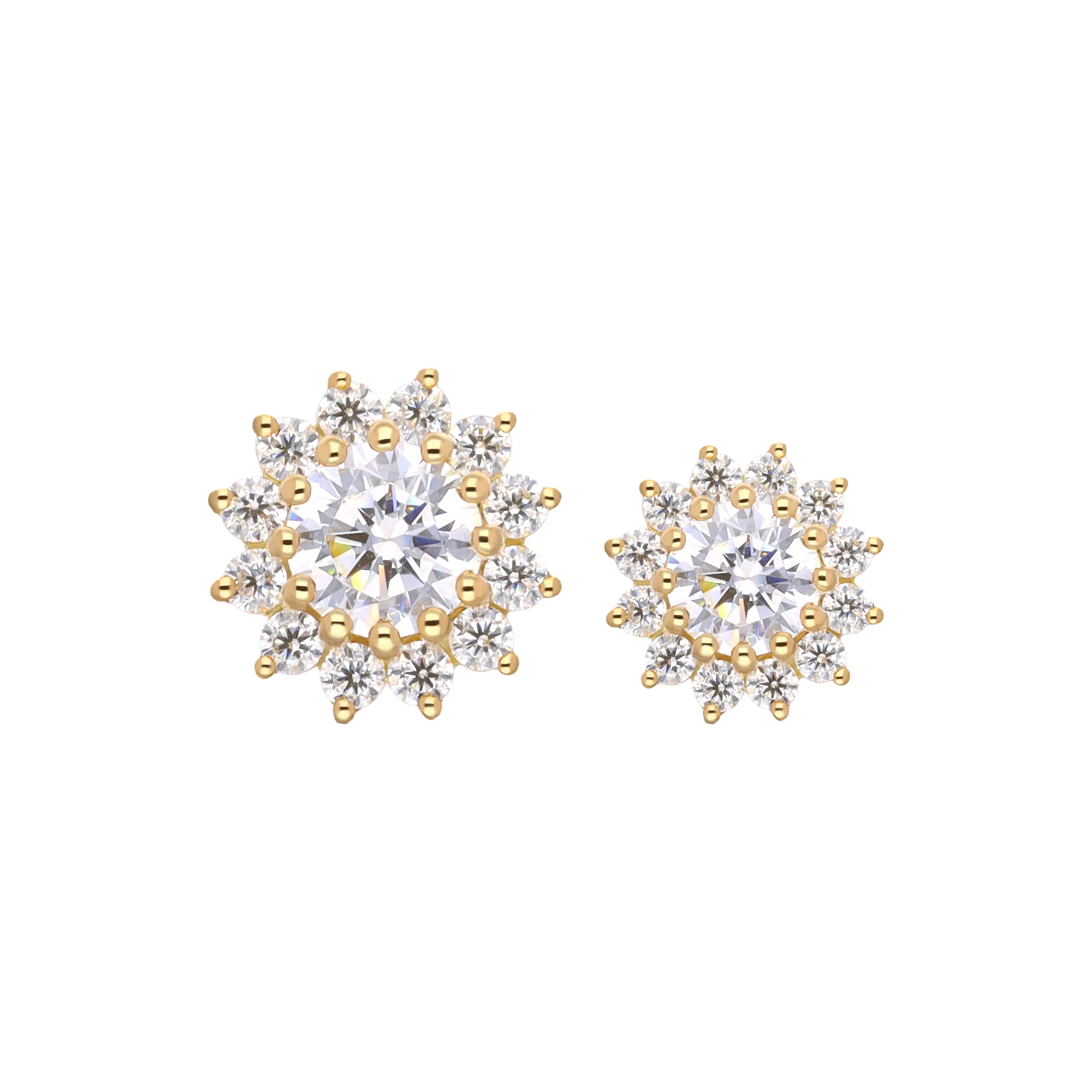
The line includes threadless tops in yellow gold with lab-grown moissanite, natural stones and Swarovski zirconia. It also includes an internally threaded top and solid 18K clicker rings in yellow and white gold. You can see them in real pieces below.
A clear gold stock has a job for each piece. Plan it by collection and colour, not only by karat.
Start with designs that already sell well in titanium at your counter. Then add stronger pieces, such as clusters and coloured stones. Other pieces in the line include Prong Push Pin - Moissanite and Prong Push Pin - Natural Tsavorite. There is also Clicker Ring - 18K Yellow Gold 16G.
Tremun Gold · Solid 18K gold · Designed and made in Italy
See Tremun 18K gold in real pieces
For professional piercers
See prices for Tremun Gold in 18K
Tremun sells only to professional piercers and studios. Register to see prices after approval.
Neither karat is better in every case. 14K is 58.5% gold, with a lighter yellow. 18K is 75% gold, with a deeper, warmer yellow, and suits signature pieces and curated ears. Hardness depends on the alloy and how it is worked, not on karat alone. Both sit inside the APP window of solid 14K to 18K.
Yes. The APP lists solid 14K gold or higher for initial jewellery. It also sets requirements for the alloy, so read its full wording on the APP website. Plated, filled and vermeil pieces are not accepted for fresh piercings. Ask your supplier for the alloy and a written karat declaration, and follow your own studio protocol.
18K holds 75% gold, against 58.5% in 14K. That is about 1.28 times the gold per gram. 18K is also denser, so the same design is roughly 15–20% heavier. Together, the same 18K yellow piece holds about 1.5 times the pure gold of 14K yellow. The price follows the metal.
No. The APP considers only gold above 18K too soft for body jewellery. Hardness depends on the alloy and how it is worked, not on karat alone. Many common 18K yellow alloys are as hard as 14K yellow, or harder. Every gold piece shows fine marks with wear, and a hand polished, mirror finish can be restored.
Often, but not always. Many white gold pieces in the jewellery trade carry a thin rhodium coating for a brighter white. The coating wears on contact points, and the base alloy then shows. Some palladium white alloys need no plating. Ask your supplier whether each white gold piece is plated, and what the base alloy is.
No. APP guidance does not accept gold-plated, gold-filled or gold overlay and vermeil pieces for fresh piercings. All of these put a thin gold layer over a base metal. The layer can wear or chip off with time. Solid gold is the same alloy all the way through, so the surface can be re-polished.
Ask for the karat and the full alloy in writing. For white gold, ask whether the piece is plated. Ask for an EN 1811 nickel-release test report and a declaration or certificate for the batch. Small pieces are often not stamped, so a written declaration matters. Tremun shares documentation on request via WhatsApp +34 675 014 620.
Make one small, gentle bend in the pin, then push the top into the post. Check the tension with a light pull. Do not over-bend, and do not re-bend the same point many times. Check the pin gauge listed on the product against your posts. Follow the bend guidance from the maker of each piece.
Use an ultrasonic cleaner with caution. Some stones and some settings may not suit ultrasonic cleaning. Mild soap, warm water and a very soft brush usually work for gold pieces. Check with your supplier about the specific stone and setting before you clean it.
Tremun sells only to professional piercers and studios. Register at tremunpiercing.com/registration/ and our team checks each account. Prices are visible after approval. There is no minimum order, and DHL Express shipping is free from €350 (VAT incl.). Our renewed 18K line is designed and made in Italy, hand polished, mirror finish.
The Tremun Team
 English English
 Croatian
 Dutch
 French
 German
 Italian
 Romanian
 Spanish
 Ukrainian